
Animal Ambassadors
An Animal Ambassador is an animal who lives in human care and is a representative for their species. They are educators and help us teach about our wildlife neighbors. They attend educational programs to give visitors an up-close experience with species they may otherwise not see. Our goal is to inspire empathy for our wildlife neighbors through education and conservation.
Please note; the Kalamazoo Nature Center is not a rehab facility; we do not take injured or orphaned wildlife. Visit the DNR’s website to find a rehabber near you.
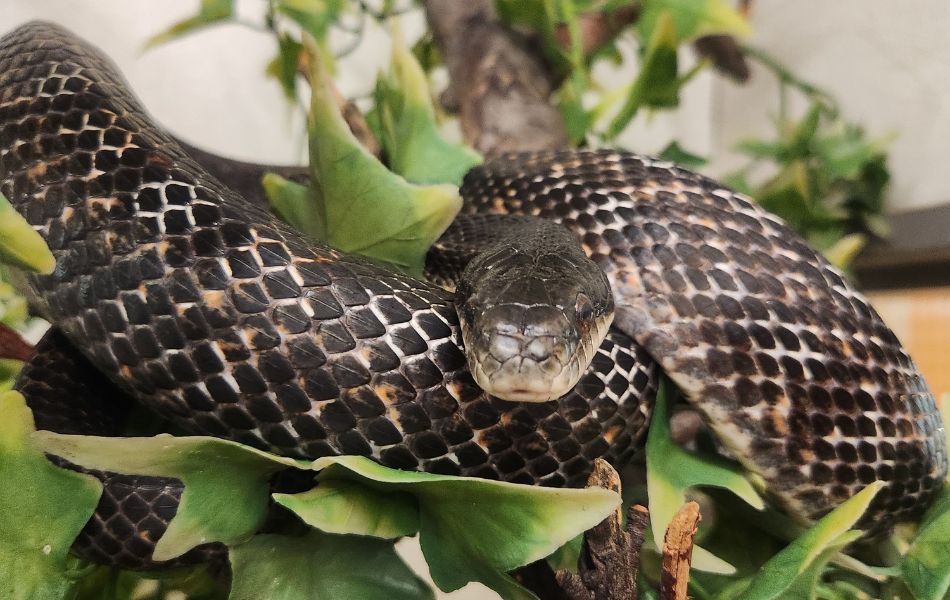
Charlie
Central gray rat snake, Pantherophis spiloides
Sex: M | Age: 12 in 2025 | Arrived in 2013
Charlie was purchased from a licensed breeder for educational programs. We provide lots of climbing opportunities for Charlie with tall branches and furniture that we rotate regularly. His favorite pastime is curling up under his rock hide.
- When threatened, rat snakes vibrate their tail to create a buzzing sound, mimicking a rattlesnake.
- Juvenile gray rat snakes prefer to eat lizards and frogs.
- Central gray rat snakes are non-venomous constrictors.
- Rat snakes are an arboreal species.
DIET
In nature: mice, rats, birds, bird eggs, lizards, frogs.
At KNC: rats
HABITAT
Hardwood forests, tree-lined streams and fields, swamps, marshes, farms.
Similar KNC Trail: Pioneer Woods
Weight: 0.5-2lbs
Life expectancy: 10-20 yrs in nature, 30 years in human care
Predators: egrets, hawks, foxes
Issues and learnings:
Contributions to the natural world: rodent/pest control
Habitat or population threats: listed as “of special concern” in Michigan and have habitat destruction
Take aways:
Don’t use rodenticide and be careful when driving!
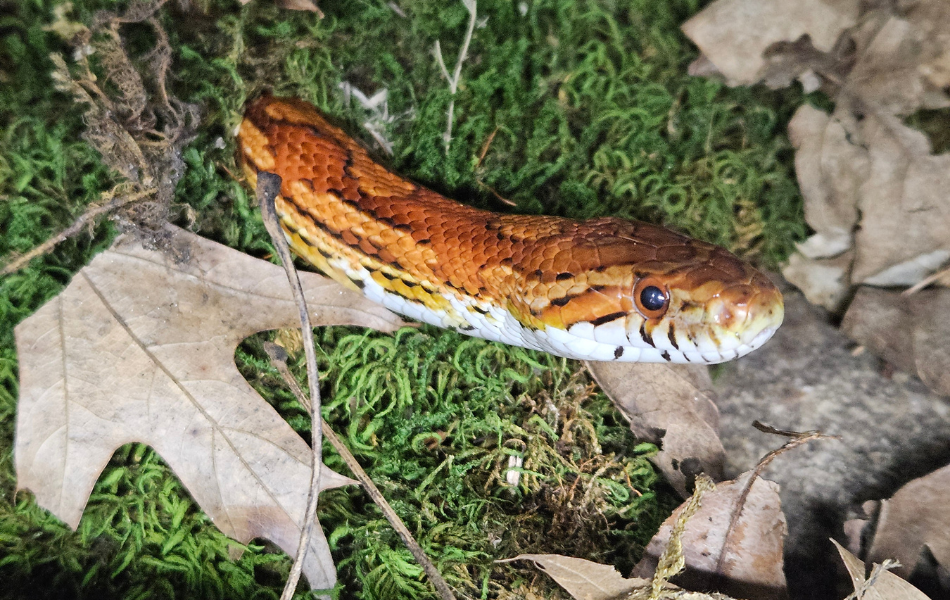
Mars
Corn snake, Pantherophis guttatus
Sex: F | Age: 2 in 2026 | Arrived in 2026
Mars was surrendered to Michigan Amphibian and Reptile Sanctuary (MARS) when her family moved and could no longer care for her. Her favorite pastime is sniffing new things. Mars is one of our most popular snakes to bring to
programs. Her calm personality means she is often willing
to participate in programming.
- The name comes from their checkered belly which resembles kernels of maize. They are often found in corn silos eating mice.
- Corn snakes spend a lot of time in underground burrows.
- Corn snakes are non-venomous constrictors.
DIET
In nature: mice, rats, birds, bats, lizards, frogs.
At KNC: mice
HABITAT
Wooded areas, rocky hillsides, barns, meadowlands.
Similar KNC Trail: Beech Maple
Weight: 0.5-2lbs
Life expectancy: 6-8 yrs in nature, 20-30 years in human care
Predators: foxes, opossums, skunks, bobcats, weasels
Issues and learnings:
Contributions to the natural world: rodent/pest control
Habitat or population threats: listed as “of special concern” in Florida, they’re protected in Georgia due to habitat loss and are often taken from the wild for the pet trade, but captive breeding programs have helped resolve the issue. Now they are the most bred snake in the pet industry.
Take aways:
Don’t use rodenticide, and they resemble venomous copperhead and are often killed as a result.
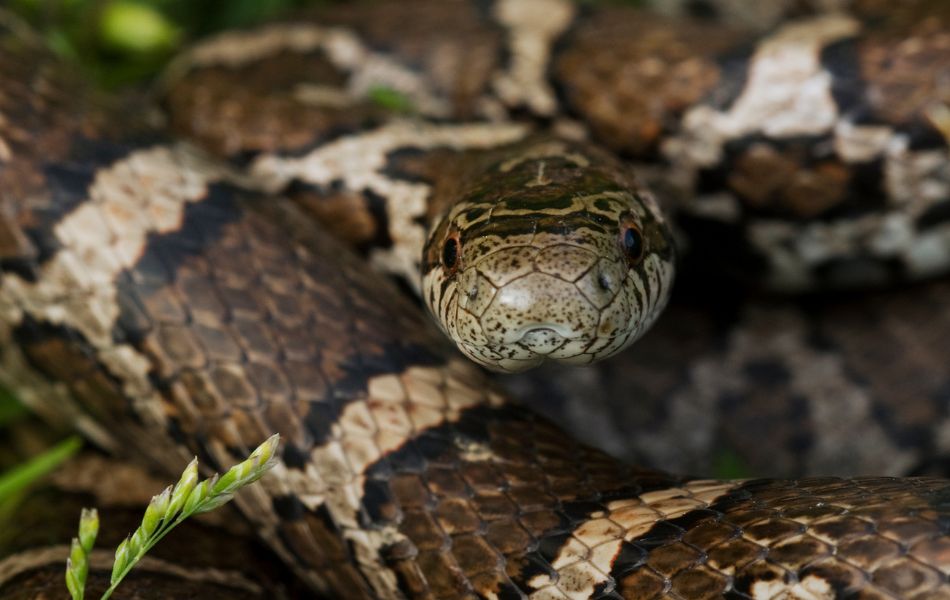
Pip
Eastern Milk Snake, Lampropeltis triangulum
Sex: M | Age: ~20 in 2025 | Arrived in 2001
Pip was bit by someone’s dog and had to have the lower half of his tail amputated. He often has difficulty shedding his skin. To help him, we provide humidity hides, sphagnum moss, and rough furniture for him to rub against. His favorite pastime is exploring his home.
- The name milk snake comes from folklore that they drank cow’s milk. Actually, they were eating the barnyard mice.
- Their coloration varies and they can look like a wide variety of other snakes.
- Milk snakes are non-venomous constrictors.
DIET
In nature: crickets, slugs, lizards, snakes, small mammals, bird eggs, frogs, fish
At KNC: mice
HABITAT
Open woodland, forested areas, swamps, farmland, prairie
Similar KNC Trail: Beech Maple
Weight: <0.5lb
Life expectancy: 12 yrs in nature, 21 years in human care
Predators: snakes, birds, opossums, skunks, raccoons, coyotes
Issues and learnings:
Contributions to natural world: Rodent/pest control
Impacts of changing climate on population: Habitat or population threats
Population pressure due to the pet trade. They are now often bred in captivity.
Take aways:
Don’t use rodenticide!
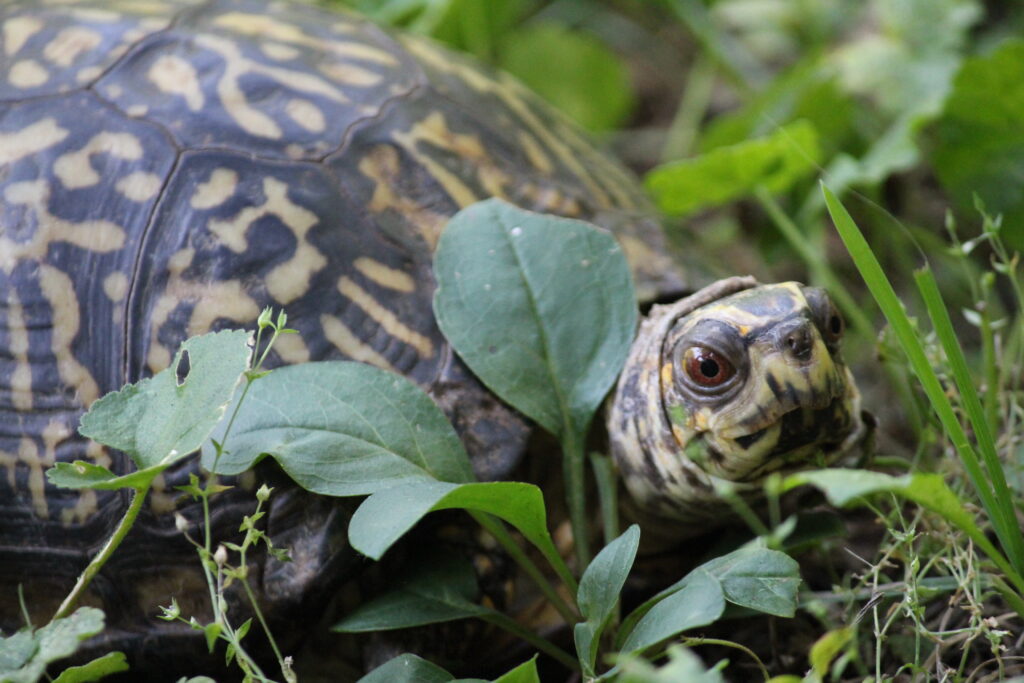
Preschool
Eastern box turtle, Terrapene carolina
Sex: F | Age: ~20-25 in 2025 | Arrived in 2017
Preschool was picked up from the wild and moved too far from her home. She moved to KNC from Nature’s Way Preschool. Her favorite pastime is sleeping next to her roommates.
- Box turtles have a hinge on the bottom of their shell that allows them to fully close their shell, like a box!
- Eastern box turtles love to burrow in the ground. We provide deep substrate so our turtles can dig and bury themselves.
- Eastern box turtles have 5 toes on their front feet and 4 toes in back.
DIET
In nature: invertebrates, berries, flowers, eggs, leafy greens, mushrooms, carrion.
At KNC: worms, crickets, produce
HABITAT
Woodlands, shrubby grasslands, meadows, near ponds or streams.
Similar KNC Trail: Fern Valley
Weight: 1-2lbs
Life expectancy: 30-40 yrs, can live up to 100 yrs
Predators: ravens, crows, herons, raccoons, foxes, coyotes
General ways to tell them apart:
Preschool is the largest and has the darkest shell. Her pattern kind of looks like fingerprints
Shelly has a very small, thick shell due to malnutrition as a young turtle.
Lefty is missing a leg but also has “S” on her shell
Carolina has more yellow on her face and the black on her shell fades towards the bottom. The bottom part of her shell is more yellow.
Crouton has a ton of yellow on his shell and very little black. He also has vibrantly red eyes.
Issues and learnings:
Impacts of changing climate on population: Box turtles have temperature dependent sex determination. Eggs incubated between 70-80 degrees are more likely to be male and eggs incubated over 82 degrees or below 70 degrees are more likely to be female. Due to global warming, we are more likely to see female box turtle hatching, which will hinder the population.
Habitat or population threats:
Taken illegally from the wild as pets or for the pet trade. Habitat destruction. Not considered endangered on a national level, but are a species of special concern in MI, NH, MA, CT
Take aways:
Road mortalities, helping turtles cross the road: move them in the direction they are already going. If you turn them the other way, they will likely turn themselves back around and try to cross the road again. Do not put them in a car and drive them away. Box turtles have a territory of approximately 1 mile and become confused and lost when taken outside of that range.
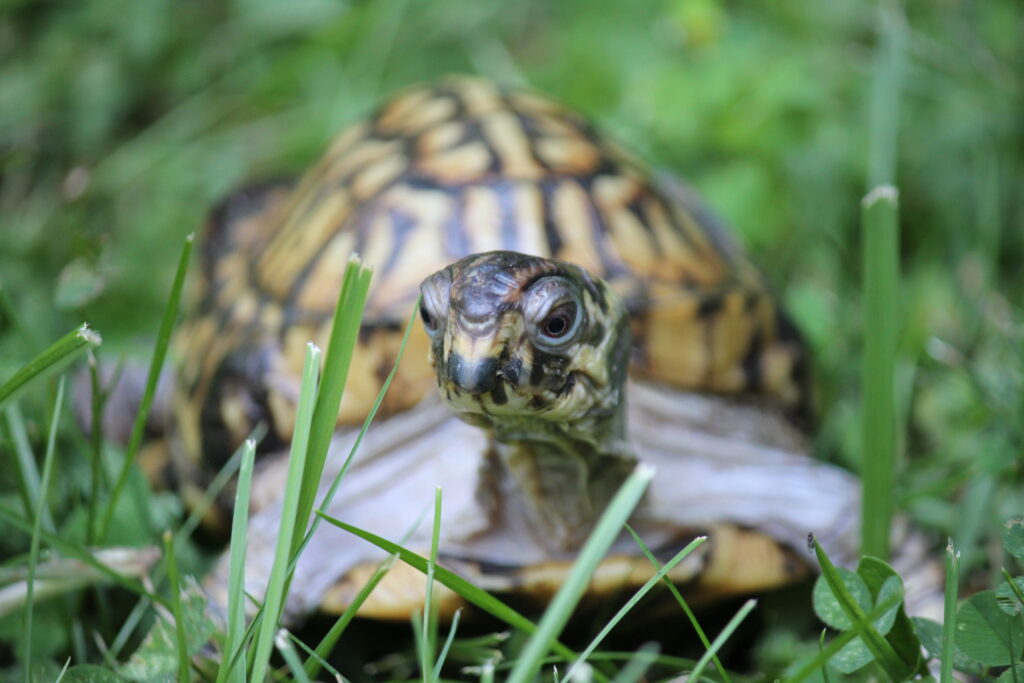
Shelly
Eastern box turtle, Terrapene carolina
Sex: F | Age: ~25 in 2025 | Arrived in 2001
Shelly was removed from her natural habitat and fed an improper diet of iceberg lettuce which did not provide all the nutrients she needed. Her shell did not grow correctly and she is unable to hide in her shell from predators. Her favorite food is crickets.
- Box turtles have a hinge on the bottom of their shell that allows them to fully close their shell, like a box!
- Eastern box turtles love to burrow in the ground. We provide deep substrate so our turtles can dig and bury themselves.
- Eastern box turtles have 5 toes on their front feet and 4 toes in back.
DIET
In nature: invertebrates, berries, flowers, eggs, leafy greens, mushrooms, carrion.
At KNC: worms, crickets, produce
HABITAT
Woodlands, shrubby grasslands, meadows, near ponds or streams.
Similar KNC Trail: Fern Valley
Weight: 1-2lbs
Life expectancy: 30-40 yrs, can live up to 100 yrs
Predators: ravens, crows, herons, raccoons, foxes, coyotes
General ways to tell them apart:
Shelly has a very small, thick shell due to malnutrition as a young turtle.
Lefty is missing a leg but also has “S” on her shell
Carolina has more yellow on her face and the black on her shell fades towards the bottom. The bottom part of her shell is more yellow.
Crouton has a ton of yellow on his shell and very little black. He also has vibrantly red eyes.
Preschool is the largest and has the darkest shell. Her pattern kind of looks like fingerprints
Issues and learnings:
Impacts of changing climate on population: Box turtles have temperature dependent sex determination. Eggs incubated between 70-80 degrees are more likely to be male and eggs incubated over 82 degrees or below 70 degrees are more likely to be female. Due to global warming, we are more likely to see female box turtle hatching, which will hinder the population.
Habitat or population threats:
Taken illegally from the wild as pets or for the pet trade. Habitat destruction. Not considered endangered on a national level, but are a species of special concern in MI, NH, MA, CT
Take aways:
Road mortalities, helping turtles cross the road: move them in the direction they are already going. If you turn them the other way, they will likely turn themselves back around and try to cross the road again. Do not put them in a car and drive them away. Box turtles have a territory of approximately 1 mile and become confused and lost when taken outside of that range.
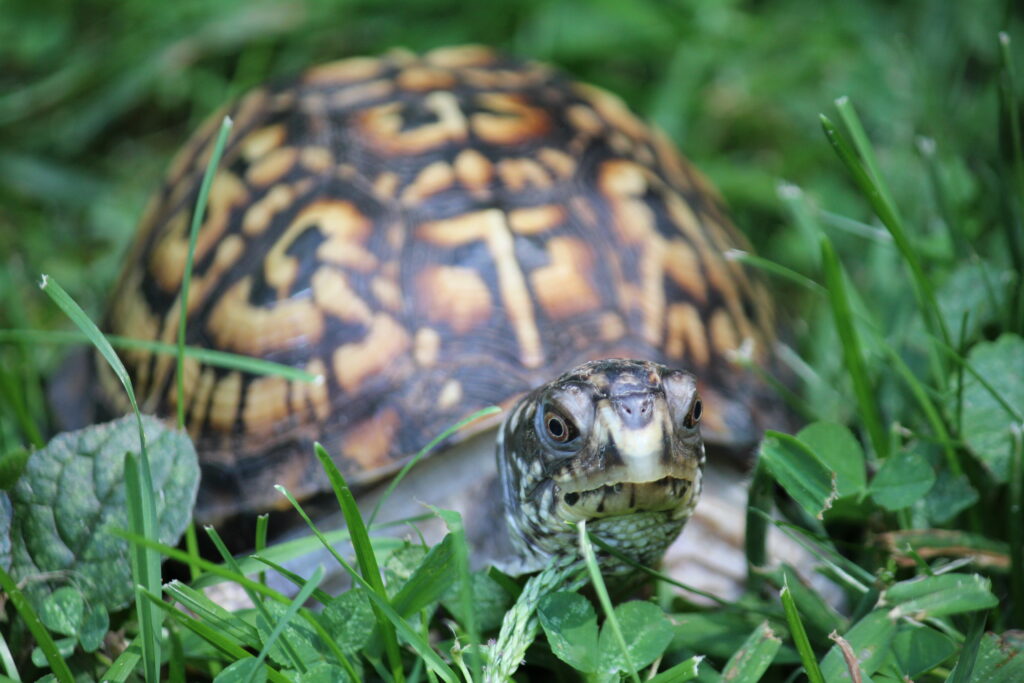
Lefty
Eastern box turtle, Terrapene carolina
Sex: F | Age: ~20 in 2025 | Arrived in 2005
Lefty was attacked by someone’s dog which caused her front left foot to be amputated. She was transferred to KNC after she healed. Her favorite pastime is burying herself under the substrate.
- Box turtles have a hinge on the bottom of their shell that allows them to fully close their shell, like a box!
- Eastern box turtles love to burrow in the ground. We provide deep substrate so our turtles can dig and bury themselves.
- Eastern box turtles have 5 toes on their front feet and 4 toes in back.
DIET
In nature: invertebrates, berries, flowers, eggs, leafy greens, mushrooms, carrion.
At KNC: worms, crickets, produce
HABITAT
Woodlands, shrubby grasslands, meadows, near ponds or streams.
Similar KNC Trail: Fern Valley
Weight: 1-2lbs
Life expectancy: 30-40 yrs, can live up to 100 yrs
Predators: ravens, crows, herons, raccoons, foxes, coyotes
General ways to tell them apart:
Lefty is missing a leg but also has “S” on her shell
Carolina has more yellow on her face and the black on her shell fades towards the bottom. The bottom part of her shell is more yellow.
Crouton has a ton of yellow on his shell and very little black. He also has vibrantly red eyes.
Preschool is the largest and has the darkest shell. Her pattern kind of looks like fingerprints
Shelly has a very small, thick shell due to malnutrition as a young turtle.
Issues and learnings:
Impacts of changing climate on population: Box turtles have temperature dependent sex determination. Eggs incubated between 70-80 degrees are more likely to be male and eggs incubated over 82 degrees or below 70 degrees are more likely to be female. Due to global warming, we are more likely to see female box turtle hatching, which will hinder the population.
Habitat or population threats:
Taken illegally from the wild as pets or for the pet trade. Habitat destruction. Not considered endangered on a national level, but are a species of special concern in MI, NH, MA, CT
Take aways:
Road mortalities, helping turtles cross the road: move them in the direction they are already going. If you turn them the other way, they will likely turn themselves back around and try to cross the road again. Do not put them in a car and drive them away. Box turtles have a territory of approximately 1 mile and become confused and lost when taken outside of that range.
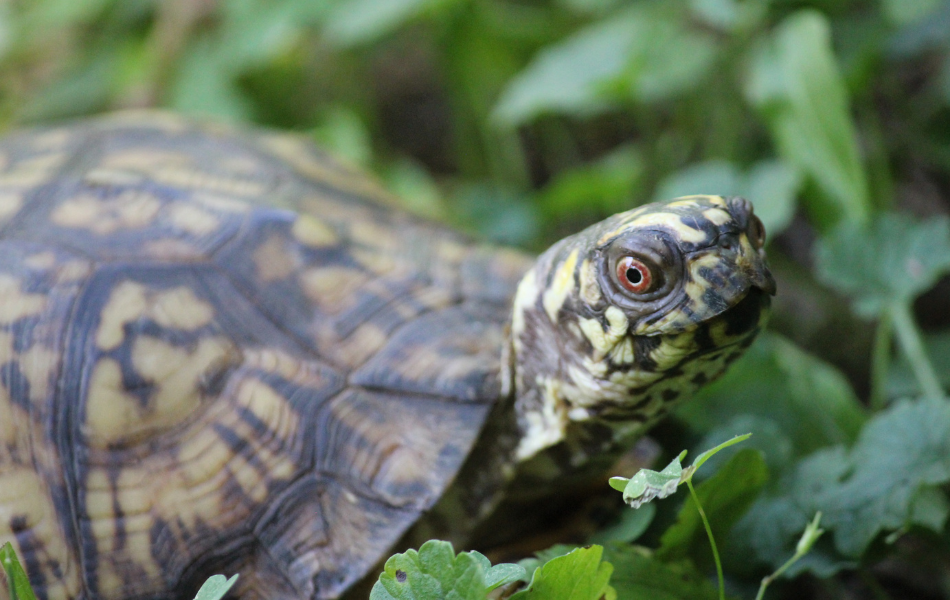
Carolina
Eastern box turtle, Terrapene carolina
Sex: F | Age: ~20-25 in 2025 | Arrived in 2008
Carolina was found with a cracked shell and taken to a wildlife rehabilitation center. She was transferred to KNC after she healed. Her favorite food is sweet potato.
- Box turtles have a hinge on the bottom of their shell that allows them to fully close their shell, like a box!
- Eastern box turtles love to burrow in the ground. We provide deep substrate so our turtles can dig and bury themselves.
- Eastern box turtles have 5 toes on their front feet and 4 toes in back.
DIET
In nature: invertebrates, berries, flowers, eggs, leafy greens, mushrooms, carrion.
At KNC: worms, crickets, produce
HABITAT
Woodlands, shrubby grasslands, meadows, near ponds or streams.
Similar KNC Trail: Fern Valley
Weight: 1-2lbs | Life expectancy: 30-40 yrs, can live up to 100 yrs | Predators: ravens, crows, herons, raccoons, foxes, coyotes
General ways to tell them apart:
Carolina has more yellow on her face and the black on her shell fades towards the bottom. The bottom part of her shell is more yellow.
Crouton has a ton of yellow on his shell and very little black. He also has vibrantly red eyes.
Preschool is the largest and has the darkest shell. Her pattern kind of looks like fingerprints
Shelly has a very small, thick shell due to malnutrition as a young turtle.
Lefty is missing a leg but also has “S” on her shell
Issues and learnings:
Impacts of changing climate on population: Box turtles have temperature dependent sex determination. Eggs incubated between 70-80 degrees are more likely to be male and eggs incubated over 82 degrees or below 70 degrees are more likely to be female. Due to global warming, we are more likely to see female box turtle hatching, which will hinder the population.
Habitat or population threats:
Taken illegally from the wild as pets or for the pet trade. Habitat destruction. Not considered endangered on a national level, but are a species of special concern in MI, NH, MA, CT
Take aways:
Behavior changes humans can adopt: Road mortalities, helping turtles cross the road: move them in the direction they are already going. If you turn them the other way, they will likely turn themselves back around and try to cross the road again. Do not put them in a car and drive them away. Box turtles have a territory of approximately 1 mile and become confused and lost when taken outside of that range.
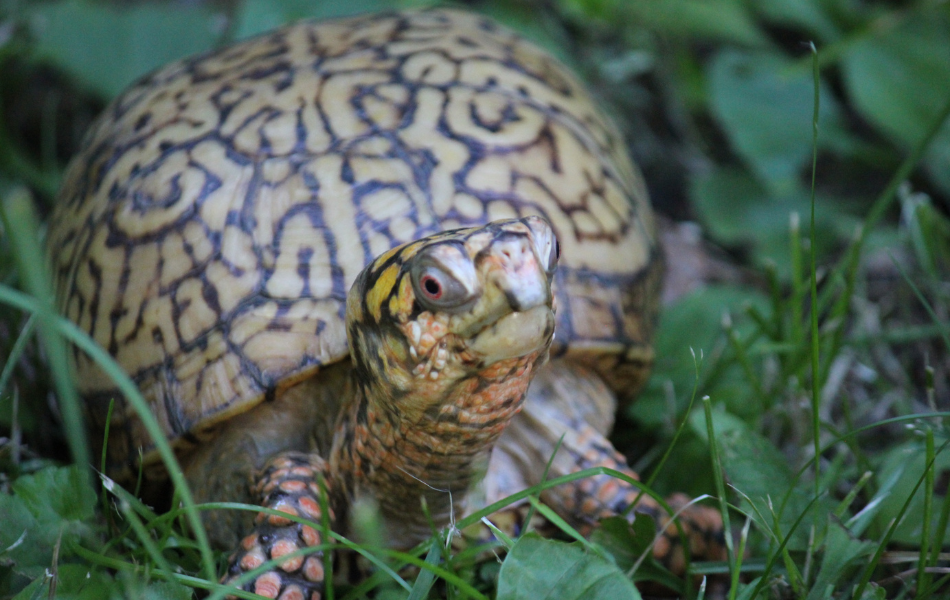
Crouton
Eastern box turtle, Terrapene carolina
Sex: M | Age: ~20-25 in 2025 | Arrived in 2005
Crouton was taken illegally out of the wild and eventually transferred to KNC. His favorite pastime is soaking in his water bowl.
- Box turtles have a hinge on the bottom of their shell that allows them to fully close their shell, like a box!
- Eastern box turtles love to burrow in the ground. We provide deep substrate so our turtles can dig and bury themselves.
- Eastern box turtles have 5 toes on their front feet and 4 toes in back.
DIET
In nature: invertebrates, berries, flowers, eggs, leafy greens, mushrooms, carrion.
At KNC: worms, crickets, produce
HABITAT
Woodlands, shrubby grasslands, meadows, near ponds or streams.
Similar KNC Trail: Fern Valley
Weight: 1-2lbs | Life expectancy: 30-40 yrs, can live up to 100 yrs | Predators: ravens, crows, herons, raccoons, foxes, coyotes
General ways to tell them apart:
Crouton has a ton of yellow on his shell and very little black. He also has vibrantly red eyes.
Preschool is the largest and has the darkest shell. Her pattern kind of looks like fingerprints
Shelly has a very small, thick shell due to malnutrition as a young turtle.
Lefty is missing a leg but also has “S” on her shell
Carolina has more yellow on her face and the black on her shell fades towards the bottom. The bottom part of her shell is more yellow.
Issues and learnings:
Impacts of changing climate on population: Box turtles have temperature dependent sex determination. Eggs incubated between 70-80 degrees are more likely to be male and eggs incubated over 82 degrees or below 70 degrees are more likely to be female. Due to global warming, we are more likely to see female box turtle hatching, which will hinder the population.
Habitat or population threats:
Taken illegally from the wild as pets or for the pet trade. Habitat destruction. Not considered endangered on a national level, but are a species of special concern in MI, NH, MA, CT
Take aways:
Behavior changes humans can adopt: Road mortalities, helping turtles cross the road: move them in the direction they are already going. If you turn them the other way, they will likely turn themselves back around and try to cross the road again. Do not put them in a car and drive them away. Box turtles have a territory of approximately 1 mile and become confused and lost when taken outside of that range.
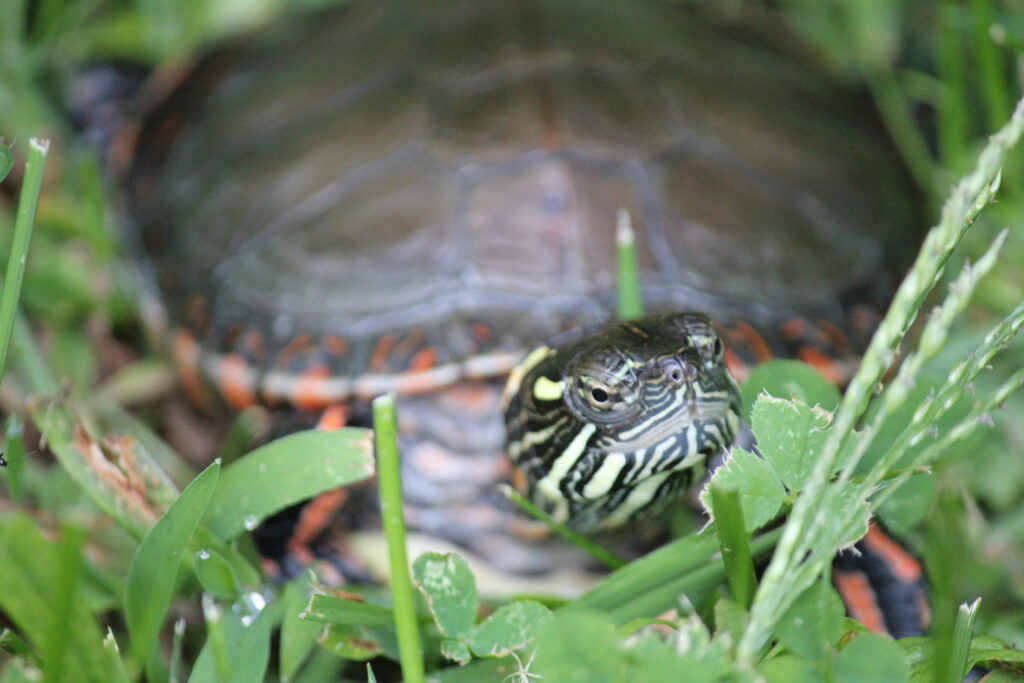
Alex
Painted turtle, Chrysemys picta
Sex: F | Age: 6 in 2025 | Arrived in 2020
Alex was found in a pool. She was removed but came back the next day. The pool chemicals stunted her growth. Her favorite pastime is saying “hi!” to guests. Alex is often seen following guests around her aquarium. She sees humans as a source of food and entertainment.
- During hibernation, painted turtles slow down their metabolism and their heart beats once every 2-3 minutes.
- Painted turtles are Michigan’s state reptile!
- When baby painted turtles are born, they instinctively head straight for the water.
DIET
In nature: invertebrates, fish, aquatic plants, algae, carrion.
At KNC: worms, crickets, pellets, produce
HABITAT
Ponds, lakes, marshes.
Similar KNC Trail: Habitat Haven
Weight: 0.6-1.1 lbs
Life expectancy: 25 yrs in nature, 50 yrs in human care
Predators: raccoons, otters, mink, foxes
Issues and learnings:
Habitat or population threats – habitat loss, but they can live in man-made lakes and ponds. Egg predation from other species.
Take aways:
Road mortalities, especially for females crossing the road to nesting sites.
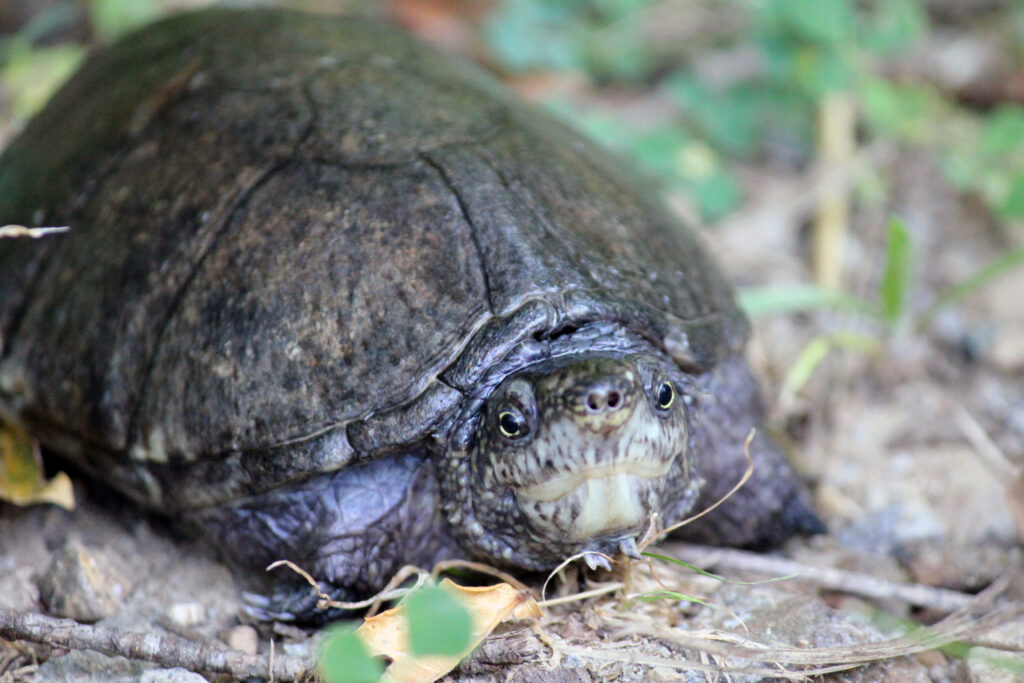
River
Musk turtle, Sternotherus odoratum
Sex: M | Age: unknown | Arrived in 2010
River was collected from his native habitat using a Collector’s Permit from the DNR. He has a slightly malformed shell. His favorite pastime is stretching out his long neck to stick his nose above the water.
- Another common name for musk turtles is “stinkpot” as they emit a stinky musk from their glands when scared.
- Musk turtle live in the shallow areas of ponds, rivers, and lakes. To mimic this, we provide a relatively low water level in his aquarium.
- Musk turtles are often confused for snapping turtles due to their large beak.
- Their smooth shell helps musk turtles swim quickly.
- Musk turtles are known to be good climbers, often climbing several feet up into trees to bask.
DIET
In nature: invertebrates, fish, algae, aquatic plants, carrion,
At KNC: worms, crickets, pellets, produce
HABITAT
Slow-moving bodies of water with soft bottoms.
Similar KNC Trail: Habitat Haven
Weight: <0.5 lb
Life expectancy: 20 yrs in nature, 50 yrs in human care
Predators: bass, pike, herons, eagles, hawks, raccoons, otters, foxes
Take aways:
Buy organic produce to reduce the amount of pesticide and herbicide use. Runoff of these chemicals pollutes local waterways and harms aquatic wildlife.
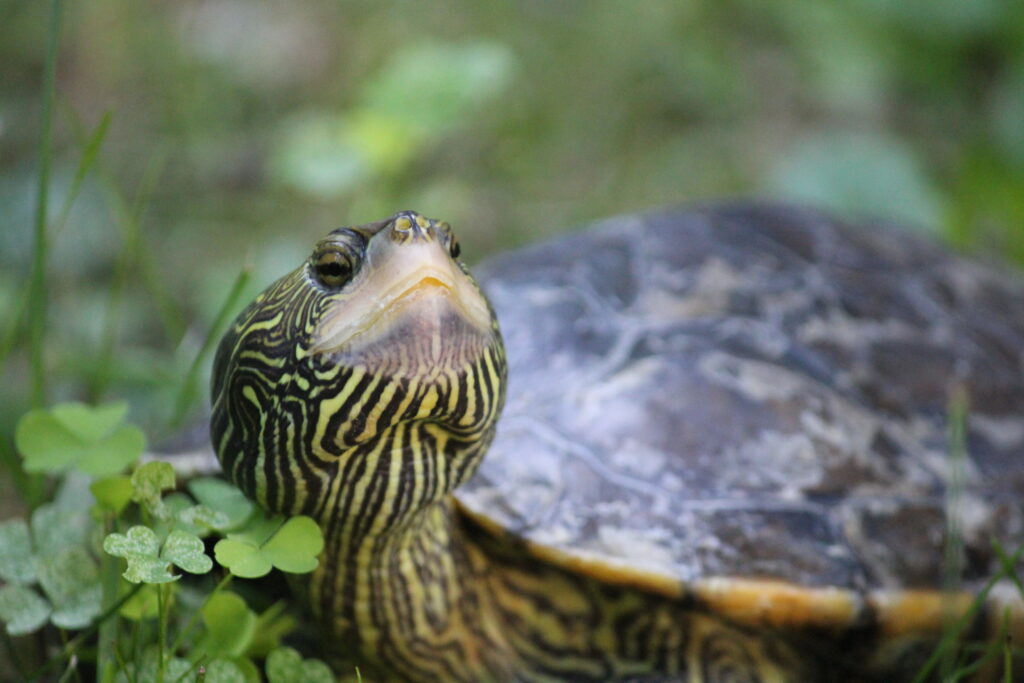
Clark
Common Map Turtle, Graptemys geographica
Sex: F | Age: unknown | Arrived in 2025
Clark was transferred to KNC from the St. Louis Aquarium because she was the smallest turtle and often outcompeted for food in her enclosure. Clark often has trouble shedding scutes– the thin top layer of her shell– so we’ve provided a brush for her to rub her shell against in her aquarium. Her favorite pastime is saying “hi!” to guests.
- Their name comes from the lines decorating their shell and skin which resemble topographical lines on a map.
- Map turtles often bask in groups but will slip into the water at the first sign of danger.
- Map turtles hibernate at the bottom of large bodies of water during the winter.
DIET
In nature: snails, mussels, crayfish, invertebrates, occasional vegetation.
At KNC: worms, crickets, pellets, produce
HABITAT
Wetlands with large bodies of water.
Similar KNC Trail: Source Pond
Weight: males: 0.3-0.9lbs females: 1.5-5.5lbs
Life expectancy: 15-30 yrs wild, 50 yrs in human care
Predators: raccoons, coyotes, skunks
Take aways:
Protect our waterways. Litter and chemical runoff from agriculture and construction can pollute our waterways. Most ponds, streams, and rivers connect to other water sources. Pollution in one area can affect water quality miles away.
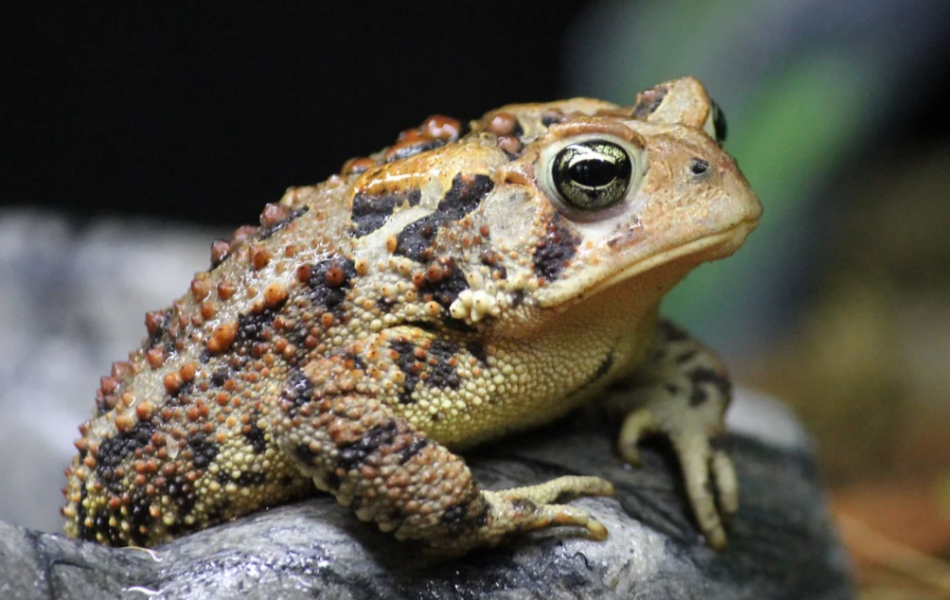
Rebecca
American toad, Anaxyrus americanus
Sex: F | Age: unknown | Arrived in 2025
She comes to us from West Michigan Wildlife Center (WMWC), a wildlife rehabilitation facility in Grand Rapids. She came to WMWC with a shattered back right leg which had to be amputated.
- American toads are often found on the forest floor amongst leaf litter. We’ve provided a similar habitat in her enclosure along with places for her to hide so she feels safe.
- It is a common myth that toads can give you warts. While they cannot transmit warts, you should always wash your hands thoroughly after handling an amphibian
DIET
In nature: invertebrates, occasionally other frogs.
At KNC: crickets, mealworms, earthworms, dubia cockroaches
HABITAT
Wetlands, woodlands, forests, swamps, residential areas.
Similar KNC Trail: Pioneer woods
Weight: <1lb
Life expectancy: 1-10 yrs in nature, over 30 yrs in human care
Predators: hognose and garter snakes, corvids, herons, raccoons
Take aways:
Don’t use insecticide. Animals that eat poisoned insects can become sick, especially after repeated exposure. Insecticide doesn’t discriminate but instead kills a wide variety of insects that are a vital food source for many animals. Instead, build a “toad house” to encourage toads to take up residence in your area and provide free bug control!
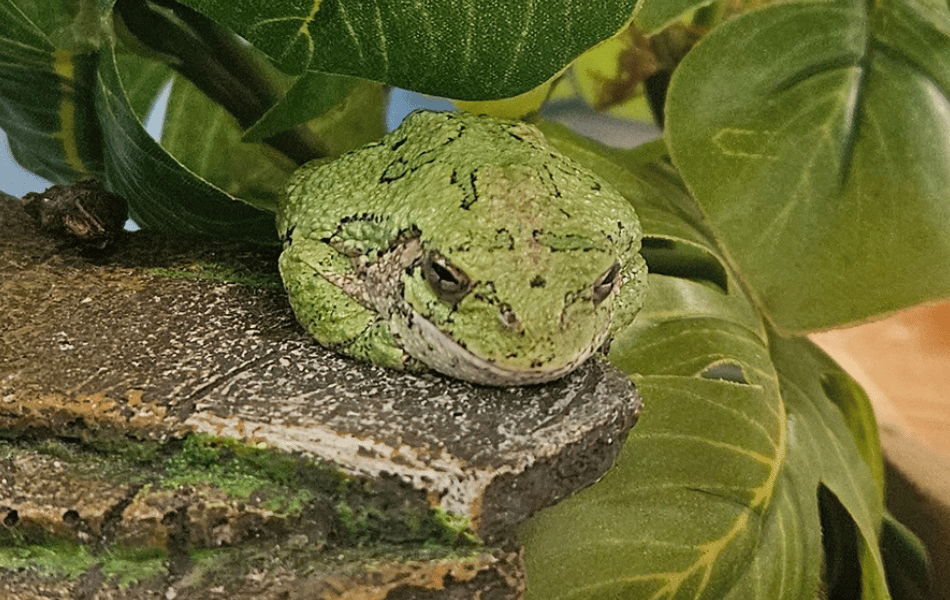
Polly
Gray tree frogs, Hyla versicolor
Sex: unknown | Age: unknown | Arrived in 2026
Polly was found on the Members Room window. They was collected under our DNR Collector’s Permit for educational programming.
- These frogs can change color from grayish green to bright green to gray to creamy white to brown!
- Gray tree frogs produce a sticky mucus through their feet pads which allows them to stick to surfaces. We often see them pressed against the glass of their enclosure.
- Gray tree frogs are able to withstand over 80% of their body freezing in winter.
- Gray tree frogs lack the strong hind legs that allow certain species to jump far distances.
DIET
In nature: invertebrates, occasionally other frogs.
At KNC: crickets, mealworms
HABITAT
Wetlands, woodlands, forests, swamps, residential areas.
Similar KNC Trail: Beech Maple
Weight: 0.25oz
Life expectancy: 7-9 yrs
Predators: birds, snakes, lizards, raccoons, skunks, fish
Take aways:
Create an amphibian habitat in your area. Plant native wildflowers, trees, shrubs, and grasses. Provide a water source and shade. These insectivorous frogs will help keep unwanted invertebrates such as mites and mosquitos away from your home.
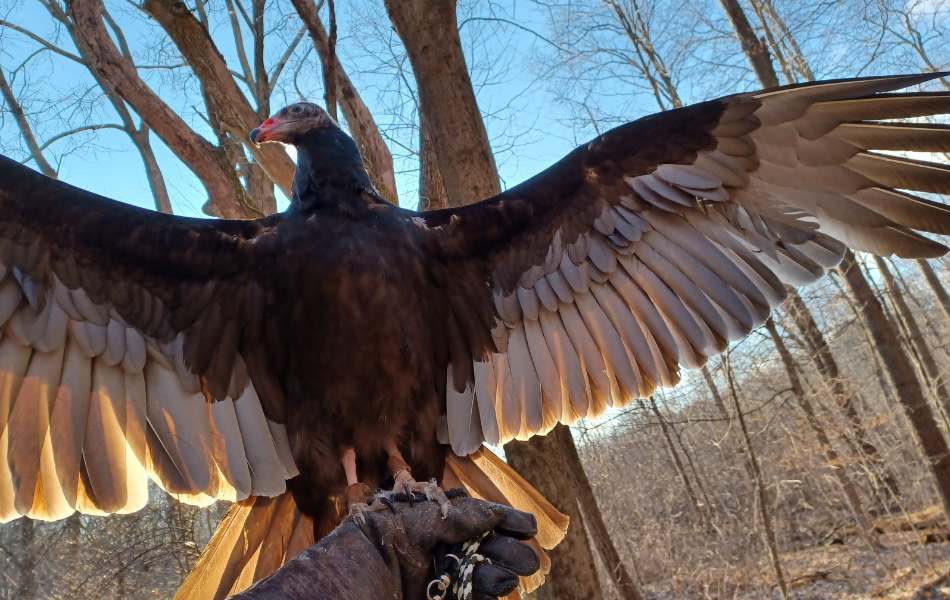
Tukey
Turkey vulture, Cathartes aura
Sex: F | Age: 4 in 2025 | Arrived in 2022
Tukey was found on the ground and brought to Wildside Rehabilitation Center. There, she became imprinted on humans. Tukey has an impressive 6ft wingspan. She loves to stand on her perches and spread her wings in the sunlight. Her favorite food is liver, especially from rats.
- Vulture stomach acid is about 100x stronger than a human. They can process anthrax, rabies, botulism, and other diseases.
- Vultures have large, open nostrils that allow them to smell over a mile away.
- When frightened, turkey vultures can projectile vomit. This is not only extremely stinky, but also makes the bird lighter, thus easier to fly away.
DIET
In nature: invertebrates, occasionally other frogs.
At KNC: crickets, mealworms, earthworms, dubia cockroaches
HABITAT
Wetlands, woodlands, forests, swamps, residential areas.
Similar KNC Trail: Pioneer woods
Weight: <1lb
Life expectancy: 1-10 yrs in nature, over 30 yrs in human care
Predators: hognose and garter snakes, corvids, herons, raccoons
Take aways:
Don’t use lead bullets or fishing hooks. Lead products leftover in animal meat or intestines is often ingested by scavenging vultures. Lead poisoning is often fatal.
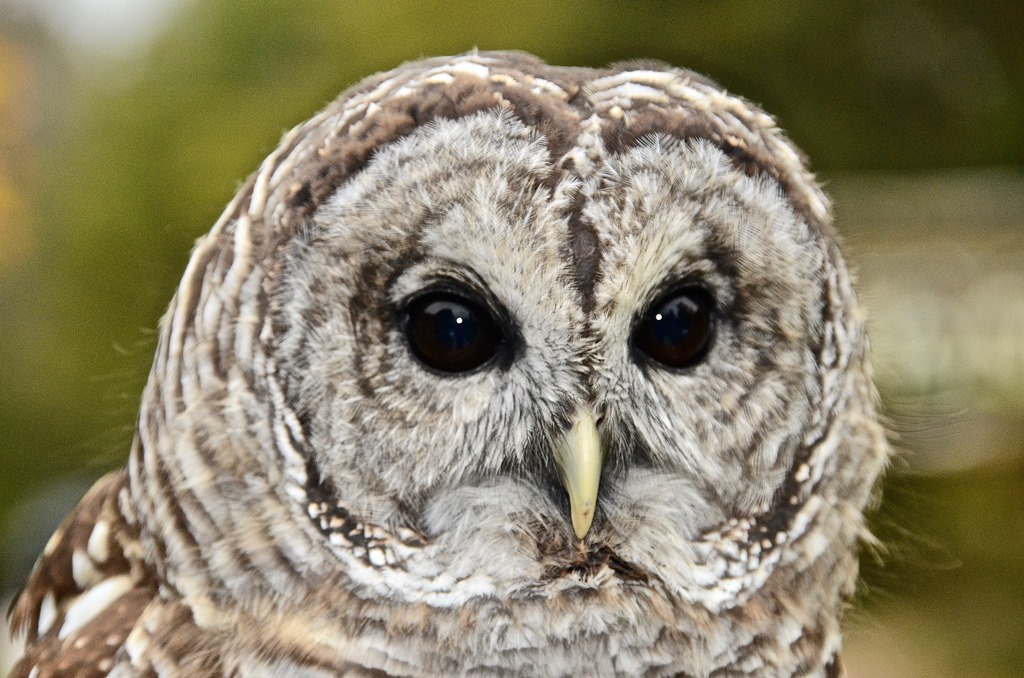
Barred
Barred owl, Strix varia
Sex: F | Age: unknown | Arrived in 2017
Barred was hit by a vehicle, causing a break in her right wing. She has limited flight capabilities. Barred was used in educational programming for many years. Due to her old age, she has been retired from programming. Her favorite pastime is snoozing on her favorite perch.
- Barred owls are known for their classic call which sounds like “Who cooks for you? Who cooks for you all?”
- Barred owls are considered invasive on the West Coast. They are encroaching on the range of the threatened spotted owl.
- Barred owls are monogamous and mate for life.
- Barred owls are named after the barring, or brown striping, across their chest.
DIET
In nature: small mammals, frogs, crayfish, snakes, lizards.
At KNC: mice, rats, quail, chicken, hamsters
HABITAT
Mixed forest, swamps, wetlands,
Similar KNC Trail: Habitat Haven
Weight: 1-2.3lbs
Life expectancy: 8-10 in nature, 20-30 in human care
Predators: great horned owls
Take aways:
Slow down when driving at night. Owls are often victims of car strikes due to their hunting patterns. Their prey are attracted to the headlights and litter surrounding roadways, and owls swoop down to hunt them.
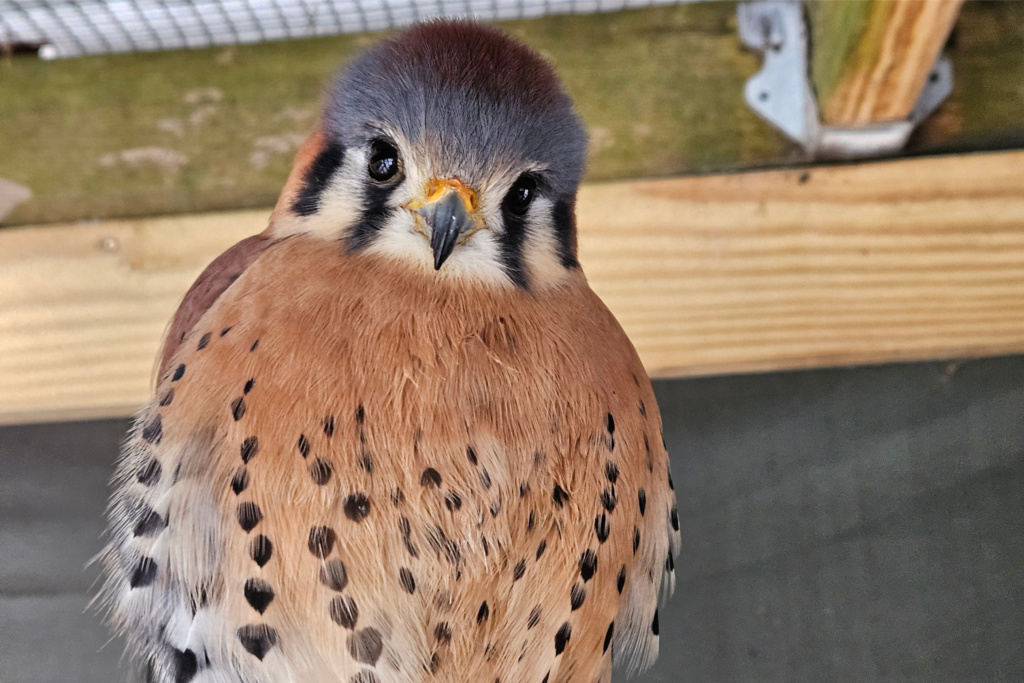
Garage (Gary)
American kestrel, Falco sparverius
Sex: M | Age: 1 in 2025 | Arrived in 2024
Garage was found on the ground as a baby and cared for by a family in their garage. He became imprinted on humans. His favorite pastime is birdwatching.
- American kestrels are sexually dimorphic, meaning the males look different than the females.
- American kestrels are cavity nesters. We have provided a nest box that Gary enjoys sleeping in at night.
- With a strong head-wind, kestrels are able to hover over a field, watching for prey.
- They have two black eye-spots on the back of their heads to deter predators.
DIET
In nature: insects, small mammals, birds.
At KNC: mice, rat, quail, chicken, hamster
HABITAT
Meadows, grasslands, prairies, farm fields.
Similar KNC Trail: Prairie Pathway
Weight: 0.17-0.26lbs
Life expectancy: 1-5 yrs in nature, 12-15yrs in human care
Predators: great horned owls, prairie falcons, bobcats, skunks, coyotes, raccoons
Take aways:
Don’t use insecticide. Animals that eat poisoned insects can become sick, especially after repeated exposure. Insecticide doesn’t discriminate but instead kills a wide variety of insects that are a vital food source for many animals.
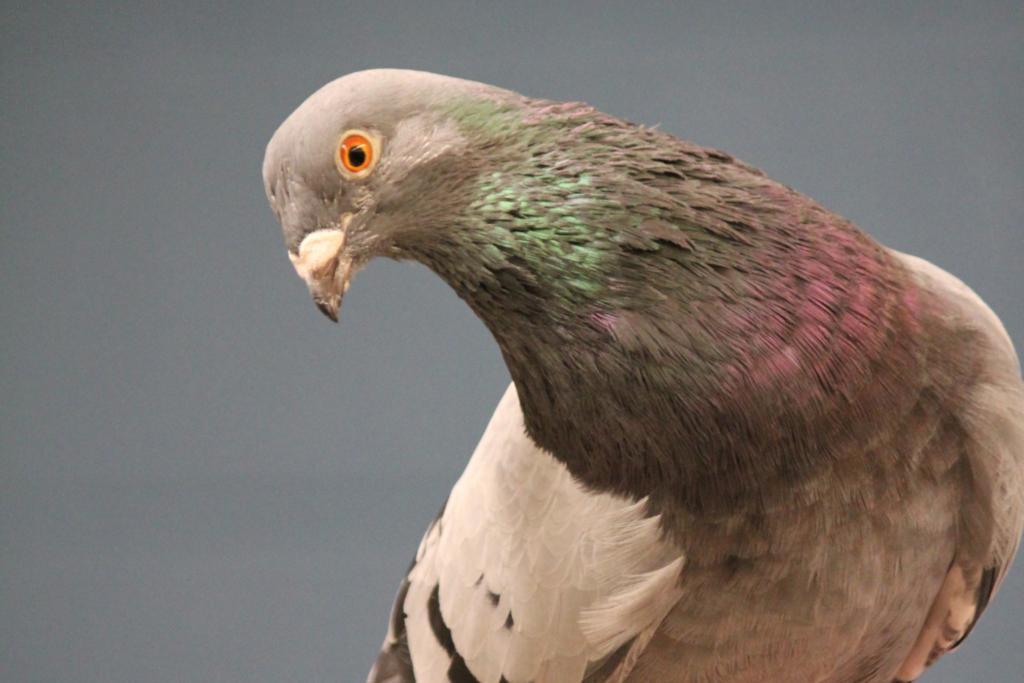
Henry
Rock Pigeon, Columba livia
Sex: M | Age: Unknown | Arrived in 2025
Henry made his way to a birthday party celebration in Oswego, IL. The family recognized that his calm behavior around humans meant he was probably someone’s pet. The owner no longer wanted him, so he was at Great Lakes Pigeon Rescue before moving to KNC. His favorite food is safflower seeds
- Pigeons come in many varieties and have been bred, like cats and dogs, for different feather colors and shapes.
- Pigeons are social animals and form complex social hierarchies. They mate for life and have been known to
form same-sex couples. We created a small pigeon flock to fulfill their social needs. - It is unknown exactly how pigeons find their way home. Some theories include using Earth’s magnetic field, a sense of smell, landmarks, or the position of the sun.
- Pigeons have a long history intertwined with humans. Egyptian hieroglyphics and Mesopotamian tablets
suggest pigeons were domesticated more than 5,000 years ago. Some believe over 10,000 years! - Head bobbing: Pigeons bob their head to help with their depth perception.
- Cooing: Cooing is a form of communication, usually between mates, which normally indicates happiness or comfort.
DIET
In nature: Seeds, fruits, rarely invertebrates.
At KNC: seed mixture, vegetables, fruit
HABITAT
Urban areas, farmland, and rocky cliffs.
Similar KNC Trail: Arboretum
Weight: 0.6-0.9lbs
Life expectancy: 2-5yrs in nature, 15+yrs in human care
Predators: falcons, hawks, owls
Take aways:
Don’t feed pigeons bread. Bread does not contain the nutrients pigeons need to be healthy. It fills them up so they have less room for more nutritious food. Continually feeding pigeons bread, especially when they’re young, can lead to a condition called angel wing which makes the bird unable to fly. Instead, feed the birds a selection of unsalted seeds.
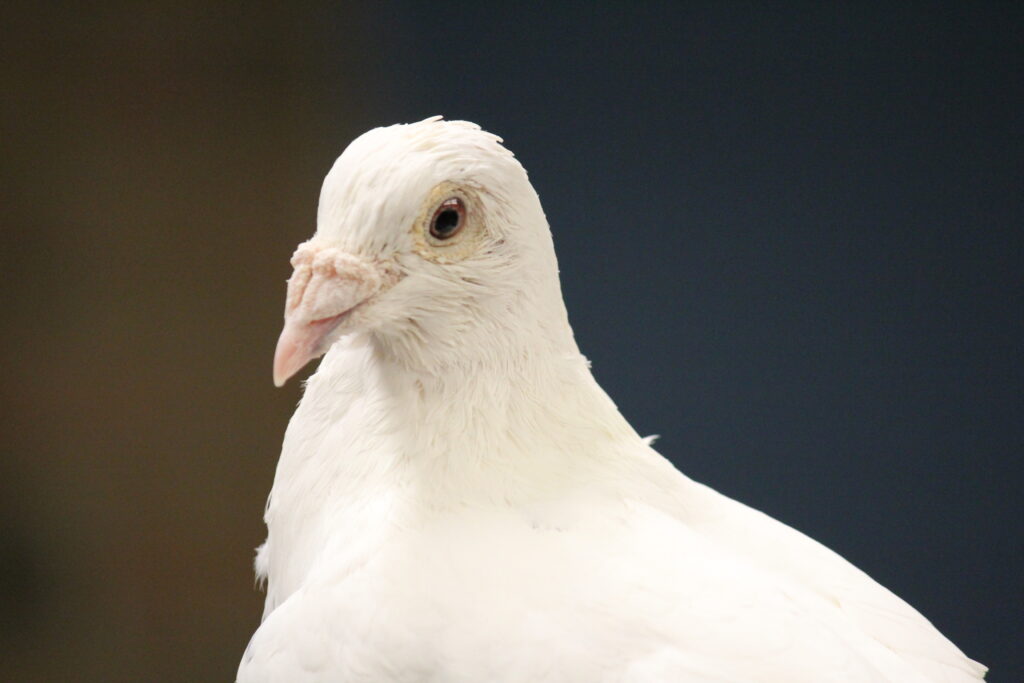
Parmesan
Rock Pigeon, Columba livia
Sex: M | Age: Unknown | Arrived in 2025
Parmesan struck a window in Plainfield, IL, likely being chased by a predator. This permanently blinded his right eye which eventually had to be removed. He was cared for at Great Lakes Pigeon Rescue before moving to KNC.
His favorite food is trapper peas.
- Pigeons come in many varieties and have been bred, like cats and dogs, for different feather colors and shapes.
- Pigeons are social animals and form complex social hierarchies. They mate for life and have been known to
form same-sex couples. We created a small pigeon flock to fulfill their social needs. - It is unknown exactly how pigeons find their way home. Some theories include using Earth’s magnetic field, a sense of smell, landmarks, or the position of the sun.
- Pigeons have a long history intertwined with humans. Egyptian hieroglyphics and Mesopotamian tablets
suggest pigeons were domesticated more than 5,000 years ago. Some believe over 10,000 years! - Head bobbing: Pigeons bob their head to help with their depth perception.
- Cooing: Cooing is a form of communication, usually between mates, which normally indicates happiness or comfort.
DIET
In nature: Seeds, fruits, rarely invertebrates.
At KNC: seed mixture, vegetables, fruit
HABITAT
Urban areas, farmland, and rocky cliffs.
Similar KNC Trail: Arboretum
Weight: 0.6-0.9lbs
Life expectancy: 2-5yrs in nature, 15+yrs in human care
Predators: falcons, hawks, owls
Take aways:
Don’t feed pigeons bread. Bread does not contain the nutrients pigeons need to be healthy. It fills them up so they have less room for more nutritious food. Continually feeding pigeons bread, especially when they’re young, can lead to a condition called angel wing which makes the bird unable to fly. Instead, feed the birds a selection of unsalted seeds.
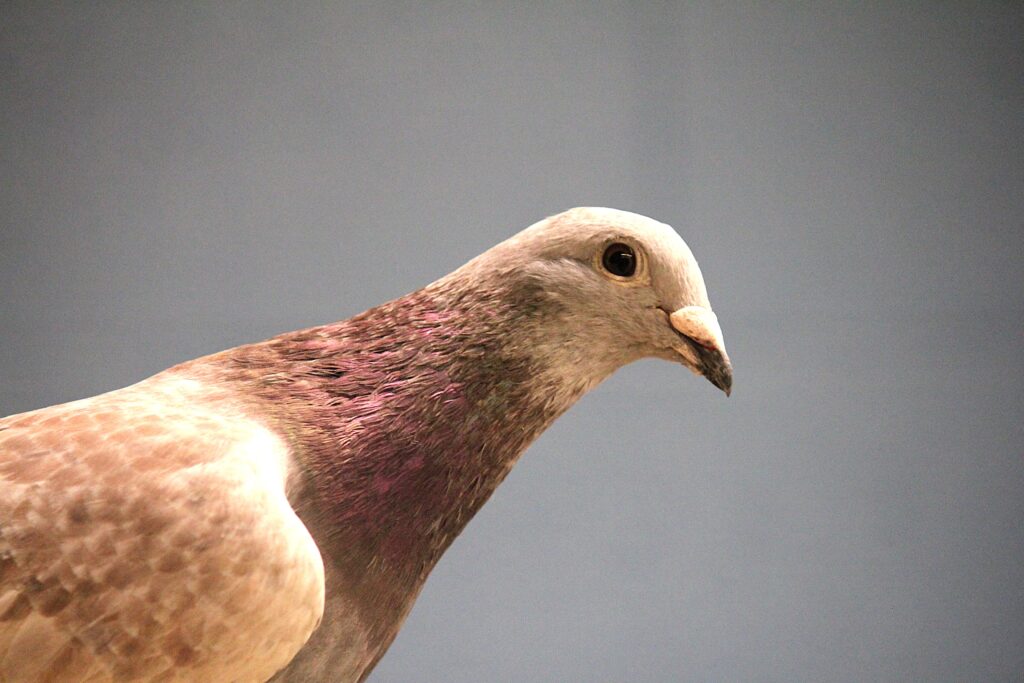
Gorgonzola
Rock Pigeon, Columba livia
Sex: M | Age: Unknown | Arrived in 2025
Ombre was found near O’Hare International Airport with a bad chest wound and a fractured leg. He was treated at Great Lakes Pigeon Rescue before moving to KNC. His favorite food is Red millet.
- Pigeons come in many varieties and have been bred, like cats and dogs, for different feather colors and shapes.
- Pigeons are social animals and form complex social hierarchies. They mate for life and have been known to
form same-sex couples. We created a small pigeon flock to fulfill their social needs. - It is unknown exactly how pigeons find their way home. Some theories include using Earth’s magnetic field, a sense of smell, landmarks, or the position of the sun.
- Pigeons have a long history intertwined with humans. Egyptian hieroglyphics and Mesopotamian tablets
suggest pigeons were domesticated more than 5,000 years ago. Some believe over 10,000 years! - Head bobbing: Pigeons bob their head to help with their depth perception.
- Cooing: Cooing is a form of communication, usually between mates, which normally indicates happiness or comfort.
DIET
In nature: Seeds, fruits, rarely invertebrates.
At KNC: seed mixture, vegetables, fruit
HABITAT
Urban areas, farmland, and rocky cliffs.
Similar KNC Trail: Arboretum
Weight: 0.6-0.9lbs
Life expectancy: 2-5yrs in nature, 15+yrs in human care
Predators: falcons, hawks, owls
Take aways:
Don’t feed pigeons bread. Bread does not contain the nutrients pigeons need to be healthy. It fills them up so they have less room for more nutritious food. Continually feeding pigeons bread, especially when they’re young, can lead to a condition called angel wing which makes the bird unable to fly. Instead, feed the birds a selection of unsalted seeds.
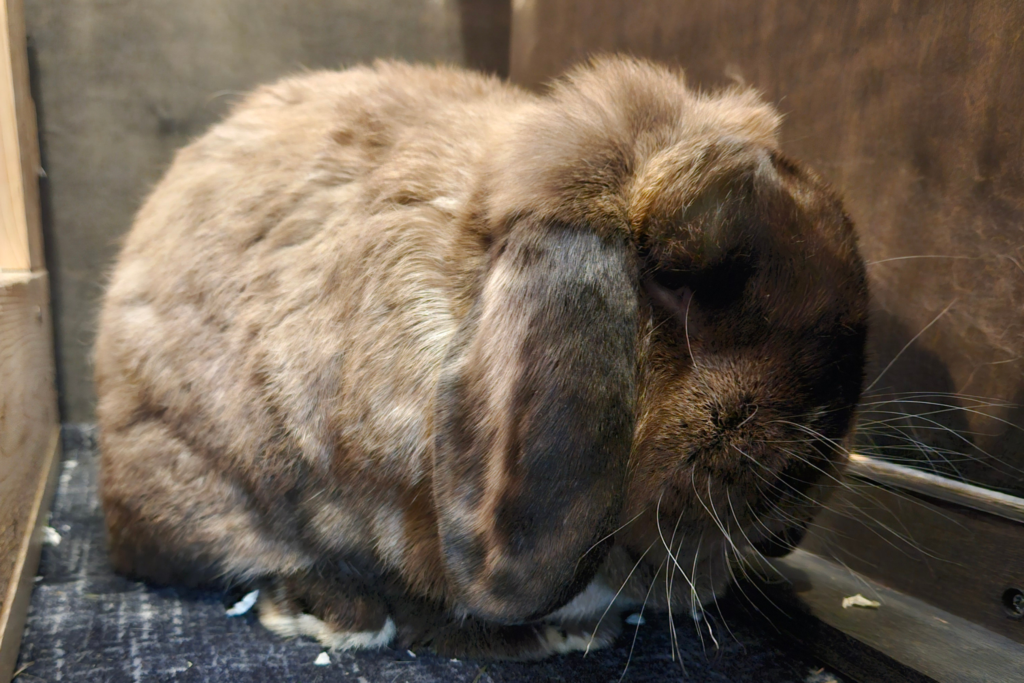
Hickory
Domestic rabbit, Oryctolagus cuniculus ssp. domesticus
Sex: M | Age: 1 in 2025 | Arrived in 2025
Hickory was found wandering outside near a farm. He was brought to a rabbit sanctuary before moving to KNC. Hickory likes to dig, so we provide him with opportunities to search through various items to find his food. His favorite food is banana.
- Rabbits have continuously growing teeth and must chew on things to keep them at a healthy length.
- Rabbits were first domesticated by the Romans for their fur and meat.
- Domestic rabbits are used to teach about the native cottontail rabbit species.
DIET
At KNC: leafy greens, herbs, pellets, hay, vegetables, occasionally fruit
HABITAT
Domesticated species
Weight: 4-5lbs
Life expectancy: 8-12 yrs
Predators: raptors, foxes, coyotes, raccoons
Take aways:
Always research before acquiring a new pet. Hundreds of rabbits are surrendered to animal shelters or dangerously released into the wild after Easter each year. Pets are a commitment in time, money, and space. Rabbit are social and should have another rabbit companion to keep them company.
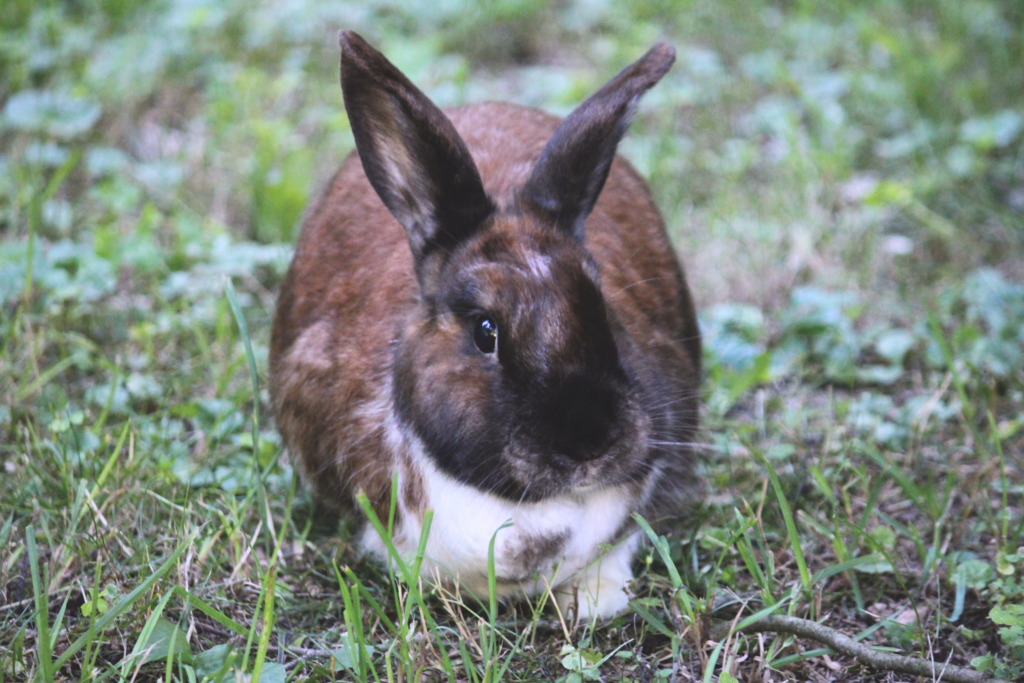
Juniper
Domestic rabbit, Oryctolagus cuniculus ssp. domesticus
Sex: F | Age: 2 in 2025 | Arrived in 2024
Juniper was acquired from a rabbit sanctuary in Wyoming, MI. She was surrendered from a home that couldn’t handle the amount of rabbits they had bred. Juniper loves to jump on top of objects. We provide her with a playground to keep her active, happy, and healthy. Her favorite food is pellets.
- Rabbits have continuously growing teeth and must chew on things to keep them at a healthy length.
- Rabbits were first domesticated by the Romans for their fur and meat.
- Domestic rabbits are used to teach about the native cottontail rabbit species.
DIET
At KNC: leafy greens, herbs, pellets, hay, vegetables, occasionally fruit
HABITAT
Domesticated species
Weight: 4-5lbs
Life expectancy: 8-12 yrs
Predators: raptors, foxes, coyotes, raccoons
Take aways:
Always research before acquiring a new pet. Hundreds of rabbits are surrendered to animal shelters or dangerously released into the wild after Easter each year. Pets are a commitment in time, money, and space. Rabbit are social and should have another rabbit companion to keep them company.
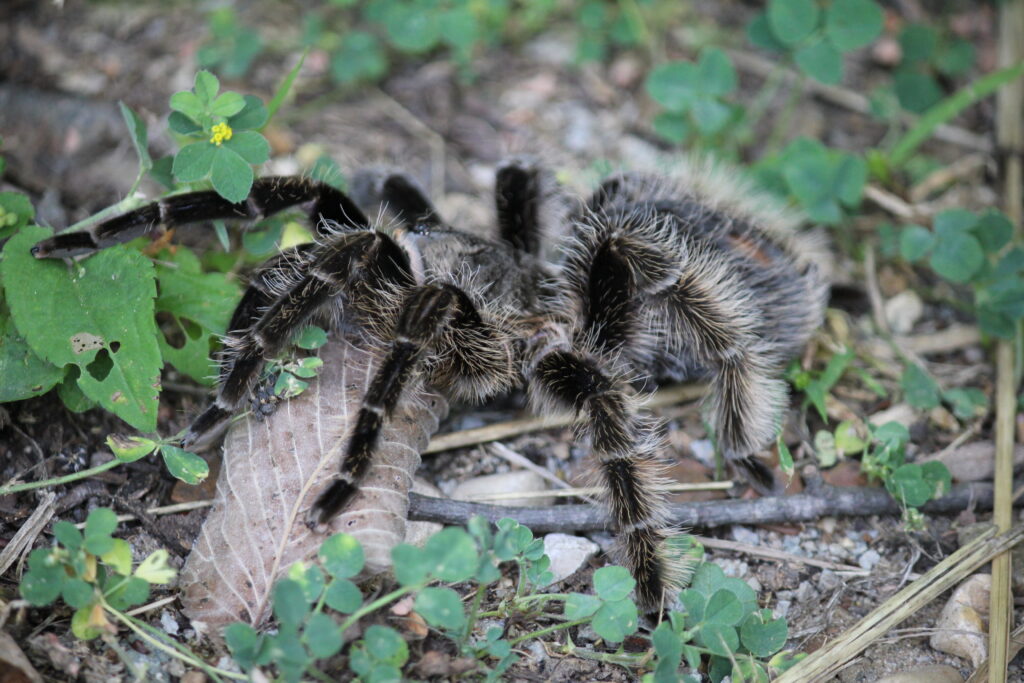
Nicaragua (Nicky)
Curlyhair tarantula, Brachypelma albopilosum
Sex: F | Age: 9 in 2025 | Arrived in 2016
Nicaragua was purchased from a breeder for educational program use. Her favorite pastime is lounging under her hide.
- The hairs on their legs can cause an allergic, itchy reaction in predators. They also help detect movement.
- Curlyhair tarantulas brush off their hairs when they are scared. We limit handling of Nicky and ensure she feels safe during educational programs.
- They use their silk as insulation and to protect their eggs rather than spinning webs.
- Tarantulas inject their prey with venom which liquefies the inside of their prey. They use their fangs to drink the liquid insides.
DIET
In nature: crickets, roaches, grasshoppers
At KNC: crickets
HABITAT
Scrubland, patches of cleared rainforest, at the base of large trees
Weight: up to 2oz
Life expectancy: 5-10 yrs for males, 20+ yrs for females
Predators: tarantula hawk (wasp), snakes, lizards, birds
Take aways:
Care about bugs. Even the smallest invertebrate has a role to play in our ecosystem. Madagascar hissing cockroaches help keep our environment clean by eating decaying matter.
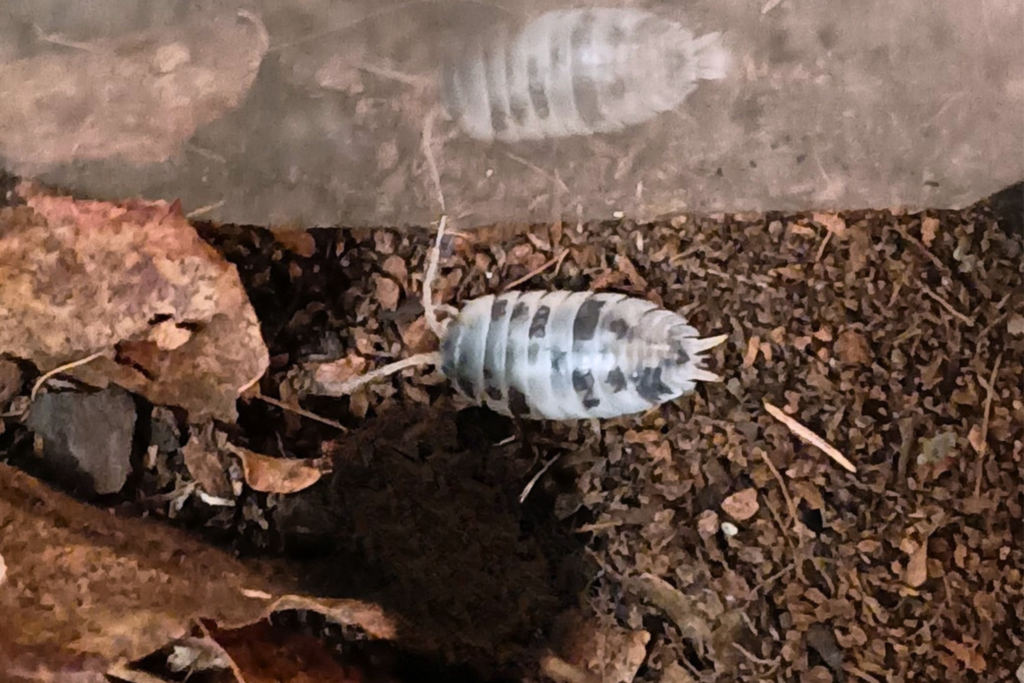
Dairy Cow Isopod
Dairy cow isopod, Porcellio laevis
Sex: M & F | Age: various | Arrived in 2025
This isopod colony was donated by a fellow staff member to be ambassadors for invertebrates and detritivores. Their favorite food is freeze-dried shrimp.
- Dairy cow isopods are an excellent clean-up crew for our resident reptiles. See if you can spot any small white-and-black invertebrates running around their homes! They help clean by eating old food and fecal matter.
- Isopods play a critical role in the environment by recycling nutrients back into the soil. They are detritivores, which means they eat decaying matter.
- Eggs and juvenile isopods develop in a brood pouch on the mother’s belly called a marsupium. The newly birthed babies are cared for by the mother before becoming independent.
- Wiggling antennae: Isopods have long antennae on their heads which help them feel and taste the environment around them.
- “Alternating turns”: Dairy cow isopods will run in a maze-line pattern to confuse predators like our native roly poly/pill bug, dairy cow isopods cannot roll into a ball. This behavior is known as conglobation
DIET
In nature: decaying wood, leaf litter, and other plant matter
At KNC: vegetables, freeze-dried shrimp
HABITAT
Shaded, damp areas such as forests, fields, and gardens
Size: 1-2cm
Life expectancy: 2yrs in human care
Predators: birds, spiders, centipedes, amphibians, newts
Take aways:
Help protect nature’s clean up crew. Properly dispose of trash, especially plastics, that the environment is unable to break down. Avoid pesticides and other chemicals that harm sensitive invertebrate species. Isopods are an excellent indicator species of good soil health.
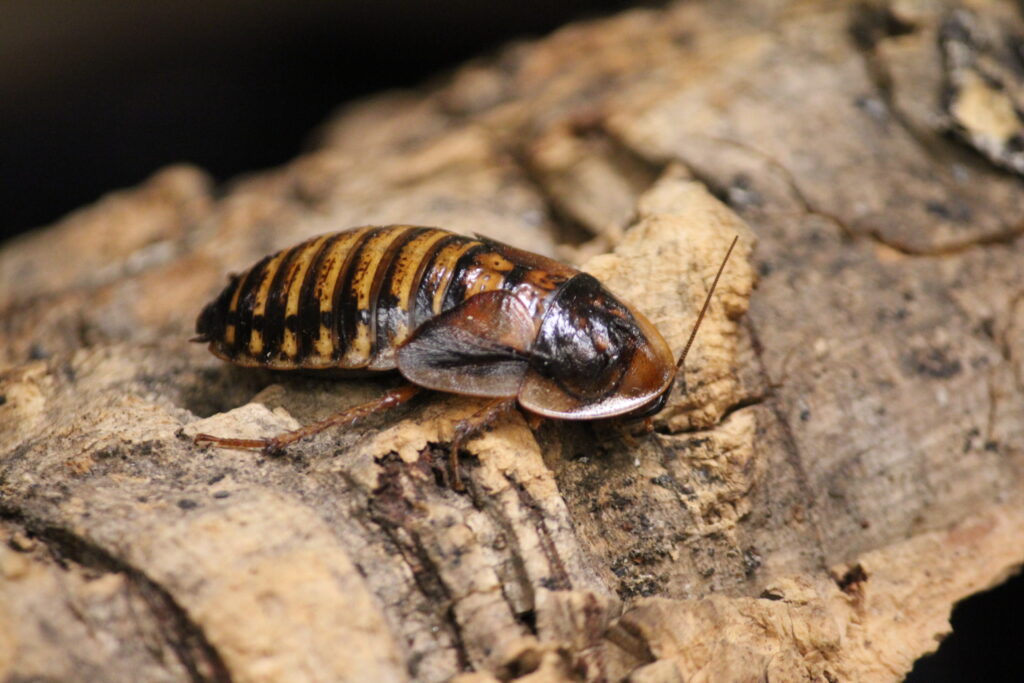
Dubia Cockroach
Dubia cockroach, Blaptica dubia
Sex: M & F | Age: various | Colony started in 2025
This colony was purchased from a breeder to become both invertebrate ambassadors and feeders for our resident animals. Their favorite food are apples.
- Dubia roaches are nocturnal forest floor dwellers. To mimic their natural habitat, we’ve provided darkened walls, leaf litter, and bark. The darkness helps them feel safer in their home.
- Dubia roaches are a social species. It has been observed that newborn roaches grow more slowly if they are separated from the adults.
- Dubia roaches are sexually dimorphic, which means they look different based on sex. Only the adult males have wings that allow them to make short flights.
- Female dubia roaches carry egg cases inside their abdomen. They hatch inside her, and then she births between 20-40 larvae.
DIET
In nature: decomposing plants
At KNC: fruits, vegetables, roach chow
HABITAT
Non-native species. Lush forests, primarily on the forest floor
Size: <1g
Length: 1.75in
Life expectancy: 6-9mo in nature, 2yrs in human care
Predators: small mammals, amphibians, reptiles, birds
Take aways:
Invertebrates, like dubia roaches, are an important food source for many animals. Help keep this important food source in our ecosystem by reducing the use of pesticides in your lawn, garden, or farm. Care about bugs! They also help eat decaying matter which keeps our earth clean and our soil nutritious for plants and animals alike.
Rodenticide
Rodenticide is just as harmful to rodents as it is to the wildlife that eats them. They are designed to entice rodents to eat them, but other wildlife such as squirrels, opossums, skunks, raccoons, and foxes will often consume the poison.
Many poisonings occur secondarily when the animal is predated on and eaten by another animal. Since rodenticide rarely leads to an immediate death, the poisoned animal becomes slow and is easier to predate on. If a predator consumes several poisoned individuals, the rodenticide bioaccumulates, or builds up, in their bodies. This often causes a slow and painful death. It is difficult for wildlife rehabilitators to identify rodenticide poisoning as there is no test for it.
Scavengers such as opossums, turkey vultures, and bald eagles are also susceptible when they eat the poisoned carcasses.
Alternatives:
- Use snap traps or electric traps to get rid of pests in the home. Never use glue traps as they are inhumane and indiscriminate- many other animals can become stuck to them.
- Seal entry points into your home. Secure food resources that may attract rodents.
- Encourage predator species such as snakes, hawks, and owls to live nearby to reduce the rodent population. Put up nest boxes for owls.
Resources:
https://wildlifecenter.org/help-advice/wildlife-issues/rodenticide-poisoning-wildlife
Habitat Destruction
There are many causes for habitat loss, including natural phenomena as well as human causes. Volcanic eruptions, tsunamis, tornados, and hurricanes are the major natural causes of habitat change and loss. Humans change the landscape through various activities such as agriculture, land development, water development, pollution, and climate change. Construction of roads, dams, houses, and commercial areas fragment habitats. These smaller sections of a habitat may not be enough to support certain species, especially migratory ones.
What you can do to help:
Consider planting native species in your yard and encourage neighbors, schools, and businesses to do the same. Offer a water source for wildlife. Native plant species not only provide food but also shelter for a variety of local wildlife. Register your space as a Certified Wildlife Habitat®!
Resources:
https://www.nwf.org/Educational-Resources/Wildlife-Guide/Threats-to-Wildlife/Habitat-Loss
https://ugc.berkeley.edu/background-content/habitat-loss-restoration/
Road Mortality/Car Strikes
Road mortalities often occur during low or moderate traffic volumes and especially at night. Drive slow at night, especially on country roads, and look out for animals attempting to cross the road, especially during migration season.
Littering increases the risk of car strikes in many species. The litter of human food attracts species such as mice, opossums, and skunks. Predator species have learned this and will often wait near roads for their prey which makes them more likely to be struck by vehicles.
What you can do to help:
- Never litter, especially out of your vehicle.
- Advocate for wildlife crossing structures to help wildlife navigate busy roadways.
Resources:
https://www.fhwa.dot.gov/clas/ctip/wildlife_crossing_structures/ch_2.aspx
https://ncwf.org/blog/road/
https://wildlifecenter.org/help-advice/wildlife-issues/message-apple-core
Nature's Clean Up Crew
Scavengers, detritivores, and decomposers are vital to the health of the ecosystem. They help break down what most animals don’t want: dead stuff. This process recycles important nutrients such as carbon, nitrogen, and phosphorous so the ecosystem can use it again.
If these dead plants and animals weren’t consumed and recycled, they would build up and nutrients would be quickly depleted. Imagine none of the fall leaves broke down. They would build on each other, year after year.
Vultures are especially important to ecosystems as their strong stomach acids are capable of processing and removing harmful diseases. Their bodies can break down rabies, botulism, anthrax, and other diseases and poisons that would otherwise spread and diminish a population.
Often given a thankless job, these animals play a vital role in keeping our ecosystem clean and healthy.
Wild Pet Trade
“According the U.S. Fish and Wildlife Service (FWS) the illegal trade of wildlife is a multi-million dollar industry. The majority die in transit from the wild to the auction block or from auction to their new homes in zoos, with private collectors, exhibitors, pet owners, and pet stores.”
Many people who attempt to care for wild animals do not have the appropriate resources, knowledge, and financial capability to do so. Additionally, it can be extremely difficult and expensive to find an exotic vet who can treat these animals.
What you can do to help:
If looking to acquire a native or non-native species, always do your research! Ensure you are able to care for that animal for the entirety of their life (turtles often live to be over 100 years old!) and for their full adult size (pythons can grow over 30 feet!). There are many rescues full of surrendered exotic pets who are looking for homes. If you are looking to purchase an animal, ensure they are coming from a reputable breeder rather than wild-caught.
Resources:
https://www.nhes.org/exotic-pet-trade/
Imprinting
Imprinting occurs within the first few hours, weeks, or months of an animals life. Birds and some mammals imprint. Imprinting is the process in which an animal learns what species they are and how to behave appropriately as that species.
Human-imprinted animals often don’t know how to hunt for themselves, what predators to look out for, or who to mate with. They don’t learn the social skills to interact with their own species.
Imprinting is an irreversible mental process that means an animal is unable to be released back to their natural habitat as they lack the necessary skills to survive.
What you can do to help:
If you find a young bird or mammal in need of help, contact a local wildlife rehabilitator. Do not attempt to raise the animal yourself. Rehabilitators know how to raise young animals to prevent imprinting so they can be released back to their natural habitat.
A list of Michigan rehabilitators can be found here: https://www2.dnr.state.mi.us/dlr/
Water Quality
Many invertebrate and amphibian species, especially salamanders, are considered indicator species. These indicator species are more sensitive than others to water quality that may be contaminated due to pollution, poor oxygenation, or other environmental factors. They have specific parameters their habitat must abide by in order for them to reproduce, grow, and thrive.
With the increase of herbicides, pesticides, fertilizers, road salt, and other toxins, runoff from rainfall and snow melt brings those chemicals into our local waterways, polluting them.
Many folks have remarked on the decline of salamanders seen in the wild. This is likely due to the declining water quality as well as fewer vernal pools. Vernal pools are ephemeral pools that occur in the springtime due to snowmelt. With drier winters, there are less vernal pools available for salamanders and other amphibians to mate in and lay their eggs.
What you can do to help:
Avoid using non-natural herbicides, pesticides, and fertilizers at home. Purchase organic produce from local farmers.
Use sand instead of road salt to provide traction on icy surfaces.
Wildlife Rehabilitaton
Wildlife rehabilitation is the care and treatment of injured, sick, or orphaned wild animals so they can be released back to the wild. In Michigan, a person must have an DNR wildlife rehabilitation permit to possess (capture, transport, house, treat, or otherwise hold) a native wild mammal or wild bird for rehabilitation purposes.
Most wild young do not need “rescuing.” Many species hide their young and return later. When in doubt, contact a permitted rehabilitator or the DNR before intervening.
Please note; the Kalamazoo Nature Center is not a rehab facility; we do not take injured or orphaned wildlife.
Visit the DNR’s website to find a rehabber near you.