Trails Open Daily 9am – 7:30pm

Trails Open Daily 9am – 7:30pm

FREE Admission Day: Saturday, September 26

Kalamazoo Valley Bird Observatory

The Kalamazoo Valley Bird Observatory (KVBO) is a program of the Kalamazoo Nature Center that is over 50 years old! Collaborative research between KVBO and government agencies, universities, and non-governmental organizations allows individual birds to be tracked as they move throughout North America. Surveys, banding, and parasite sampling allows researchers at KVBO to examine how environmental changes, pests, and diseases impact the distribution and demography of bird species.

You can support the important work the KVBO is doing!

Rich Keith
he/him/his
KVBO Director

Reports & Research
fall bird banding kalamazoo nature center

Fall Bird Banding

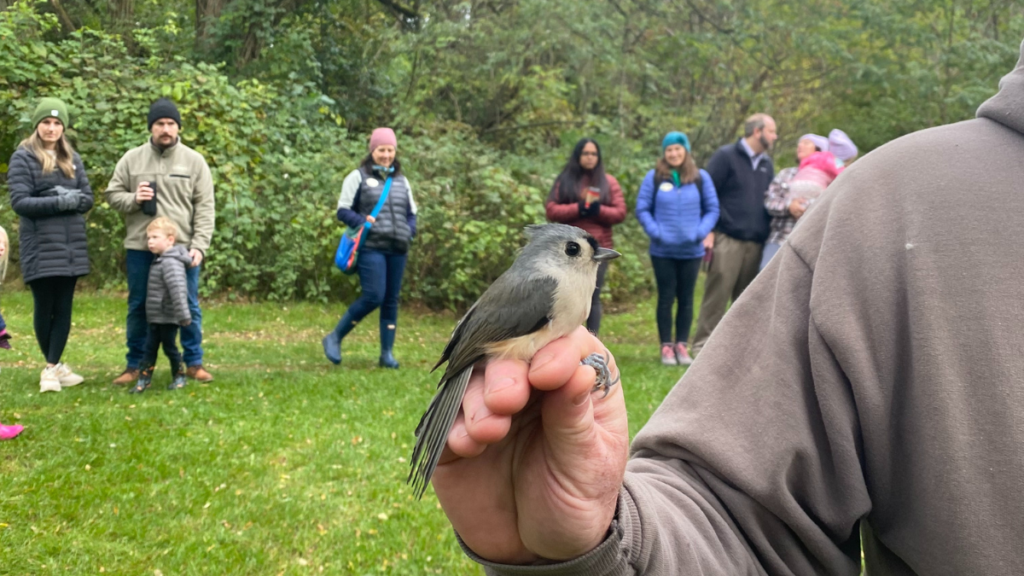
Learn all about bird banding with the seasonal banding interns! This long-running program has contributed data on over 650,000 birds to the U.S. Geological Survey’s Bird Banding Laboratory that is used for scientific research, management and conservation of birds across the country.

All banding, marking, and sampling is being conducted under a federally authorized Bird Banding Permit issued by the U.S. Geological Survey’s Bird Banding Lab. 

KVBO Annual Reports

This report covers the various birding projects and research conducted over the last year. From spring surveys to fall banding, a highlight reel of the birding work KVBO staff have completed is now available.

Donors who contribute $100 or more will receive a paper copy of this beautiful 32-page report!

Birds being banded by research staff

2026 Fall Banding Updates

September 30 - October 15, 2026
Birds being banded by research staff

It’s been quite busy the past 2 weeks, with both people and birds. The Nature’s Way Preschool classes came to see bird banding. Parents, kids, and teachers were all very excited. One day we had over 100 people visit the banding barn!

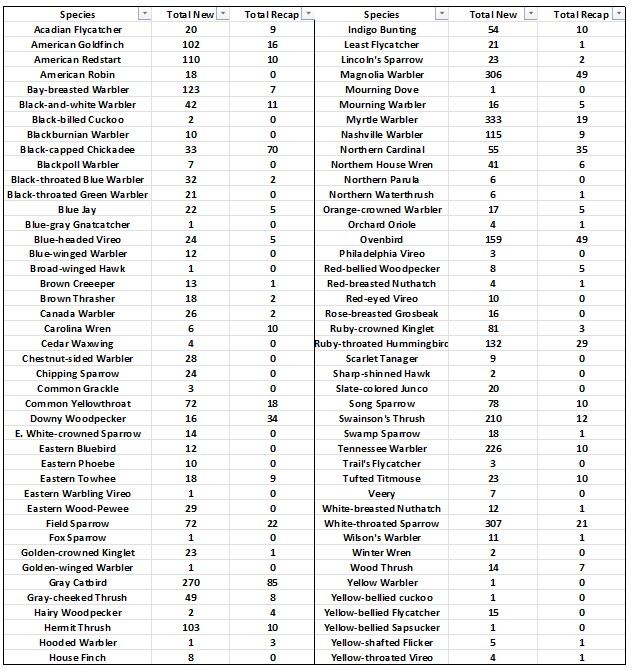
We recently had this year’s record for the number birds banded in one day, with 193 new birds and 26 previously banded birds were recaptured. Most of the birds caught that day were White-throated Sparrows and Yellow-rumped Warblers.

-Lily Hendershot

The weather is changing fast! The first two weeks of October have been a whirlwind of vastly different temperatures and bird totals for us. After days of warm weather and few birds, we knew something was different one morning. It was a much colder start of the day, and we could hear birds surrounding us everywhere. We captured quite a few birds at first and wondered if this could last throughout the day? I was banding constantly that morning and then a call over the radio asked if everyone could come out to help get birds out of the nets. Three of the nets were absolutely filled and by the end of the day we had 156 new birds banded. It was a challenge, but it was amazing to see so many birds in one day!

– Sidney

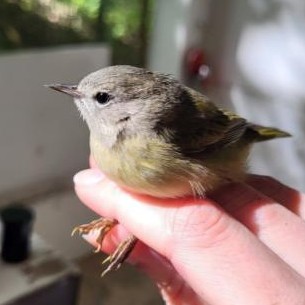
Orange-crowned warbler

“I’m very happy that the white-throated sparrows are beginning to arrive. They’re my favorite birds! But they’re not as exciting as the wood thrush we caught at Pitsfield. This wood thrush was carrying a MOTUS tag. Rich and Brenda had tagged it back in 2024, so it was very cool to recapture it. 

There have been a handful of new people who want to get involved with banding. Volunteers are always greatly appreciated. We were also visited by the conservation students from Heronwood Field Station. Both classes seemed very excited, and I hope they carry their curiosity far into the future.” 

– Lily Hendershot 

The leaves are starting to change and so are the birds in our nets! In the past few weeks, birds like warblers and hummingbirds have begun to move on and now our later migrants are starting to appear. One of the first to arrive was an Orange-crowned Warbler. Being a small, yellowish warbler, this species could easily be mistaken for a Tennessee Warbler at first, but parting the feathers on their head might just reveal a flash of orange! We now have had Ruby-crowned Kinglets, White-throated Sparrows, and many other species that indicate colder weather will be here soon. I have loved seeing the fall season progress through the new species at our nets, and I can’t wait to see what other new species arrive! 

– Sidney Collino 

Fall banding season is off to a great start! One of my favorite moments during the first few weeks was being surprised by a special bird. As a bander, you don’t always know what species is wiggling around in the bird bag you pick up. The bird in this bag was big with a black toenail sticking out of the fabric. Blue Jay? As I reached in the bag I felt a long bill. Brown Thrasher? I pulled away the bag to reveal a Black-billed Cuckoo! I was so excited to see this species up close for the very first time. I am so grateful to be able to see so many amazing birds like the cuckoo up close while working with such great people. I can’t wait to see what the rest of the fall banding season brings!

– Sidney

The first 3 weeks of banding went well! Plenty of visitors have stopped by to experience bird banding, and the volunteers have been a pleasure to work with. I’ve been able to band a few somewhat-uncommon birds, including a Blue-gray Gnatcatcher and some Orchard Orioles. I’ll be looking forward to seeing white-throated sparrows later in the season.

– Lily

Kleinstuck Spring Migration Bird Surveys

Started in 1973, this survey covers the entire spring migration period and, over the years, has documented 209 species. Check back for weekly updates from April – May each year!

See the 2025 Kleinstuck Report here>

See the 2024 Kleinstuck Report here>

See the 2023 Kleinstuck Report here >

2026 Kleinstuck Surveys

The 2025 Kleinstuck Report is coming soon!

The last week has been a little slow, adding only 6 new additions (highlighted red in the following list) putting us at 65 for the season. The Yellow-bellied Sapsuckers and Hermit Thrush numbers have increased significantly in the last week, and the Ruby-crowned Kinglets are now outnumbering their close cousin Golden-crowned Kinglets. Purple Finches have increased in the last few days with birds that probably overwintered farther south and are now moving back north. Tree Swallows have been present for a couple weeks but finally showed up at Kleinstuck. The first Blue-headed Vireo was on Monday April 13th, and we can expect a bunch more in the coming weeks. Birds to be on the watch out for this coming week would be House Wrens, Blue-gray Gnatcatchers and maybe a warbler species or two that are not Yellow-rumped, like a Black-and-white or Black-throated Green Warbler. Hoping to see a little less rain this coming week also.

Michigan Breeding Bird Atlas

Michigan Breeding Bird Atlas I & II, published in 2022, is your source for  information on breeding birds in the state of Michigan, including access to two important longitudinal studies conducted over nearly a 40 year period by the research program at the Kalamazoo Nature Center and its partner organizations. 

Purchase a limited-edition hardcover, full-color copy of the Michigan Breeding Bird Atlas II  in the Kalamazoo Nature Center’s Visitor Center!

Peer Reviewed Publications

VanTol, S.D., Koehn, C.R., Keith, R., Keith, B. and Proppe, D.S. (2021), Avian migrants encounter higher temperatures but continue to add mass at an inland stopover site in the Great Lakes region. J Avian Biol, 52:. https://doi.org/10.1111/jav.02626

Chartier, A.T., B.S. Keith, and R.S. Keith. 2021. Ruby-throated Hummingbird Movements in Southwestern Michigan. North American Bird Bander. 46(1&2): 3-8.

Keith, R. S., Keith, B.S., Scharf, W. C., & Hamer, S. A. (2015). Ixodes brunneus (Acari: Ixodidae) from Two Bird Hosts: A New Michigan Tick. The Great Lakes Entomologist, 48(3), 15.
Learn more about Ixoces brunneus here.

Van der Hoek, Y., Wilson, A. M., Renfrew, R., Walsh, J., Rodewald, P. G., Baldy, J., & Manne, L. L. (2015). Regional variability in extinction thresholds for forest birds in the north‐eastern United States: An examination of potential drivers using long‐term breeding bird atlas datasets. Diversity and Distributions, 21(6), 686-697.

Morris, S. R., Andrijević, A. S., Sullivan, R., Keith, R. S., Keith, B. S., & Sheets, H. D. (2013). An 18-year study of migration and stopover ecology of Tennessee warblers in Kalamazoo County, Michigan. The Wilson Journal of Ornithology, 125(1), 70-78.

Hamer, S. A., Hickling, G. J., Keith, R., Sidge, J. L., Walker, E. D., & Tsao, J. I. (2012). Associations of passerine birds, rabbits, and ticks with Borrelia miyamotoi and Borrelia andersonii in Michigan, USA. Parasites & vectors, 5(1), 1-11.

SELECTED OTHER PUBLICATIONS

Chartier, A. T., Baldy, J. J., & Brenneman J. (2013). Michigan Breeding Bird Atlas II. Kalamazoo Nature Center. Details here >

Brewer, R., McPeek, G. A., & Adams, R. (1991). The Atlas of Breeding Birds in Michigan. Michigan State University Press.

SELECTED ACKNOWLEDGEMENTS FOR DATA AND STAFF CONTRIBUTIONS

Zylstra, E. R., Ries, L., Neupane, N., Saunders, S. P., Ramírez, M. I., Rendón-Salinas, E., … & Zipkin, E. F. (2021). Changes in climate drive recent monarch butterfly dynamics. Nature Ecology & Evolution, 5(10), 1441-1452.

Covino, K. M., Horton, K. G., & Morris, S. R. (2020). Seasonally specific changes in migration phenology across 50 years in the Black-throated Blue Warbler. The Auk, 137(2), ukz080.

Ellis, V. A., Medeiros, M. C., Collins, M. D., Sari, E. H., Coffey, E. D., Dickerson, R. C., … & Matthews, A. E. (2017). Prevalence of avian haemosporidian parasites is positively related to the abundance of host species at multiple sites within a region. Parasitology research, 116(1), 73-80.

Corace, R. G., Korte, J. L., Shartell, L. M., & Kashian, D. M. (2016). Upland sandpiper: a flagship for jack pine barrens restoration in the Upper Midwest?. Ecological Restoration, 34(1), 49-60.

Ellis, V. A., Collins, M. D., Medeiros, M. C., Sari, E. H., Coffey, E. D., Dickerson, R. C., … & Matthews, A. E. (2015). Local host specialization, host-switching, and dispersal shape the regional distributions of avian haemosporidian parasites. Proceedings of the National Academy of Sciences, 112(36), 11294-11299.

Hamer, S. A., Hickling, G. J., Sidge, J. L., Rosen, M. E., Walker, E. D., & Tsao, J. I. (2011). Diverse Borrelia burgdorferi strains in a bird-tick cryptic cycle. Applied and environmental microbiology, 77(6), 1999-2007.

Please contact us for a complete publication list or if you are interested in viewing a historic publication.

Add to your birding list on a hike!